
Resource Guide | Baseball & Softball Gloves by Position
One of the most important things to consider when choosing a glove is what position you will be playing. The gloves for each specific position have certain attributes that help the player at his or her position.
Webbing of a Glove by Position
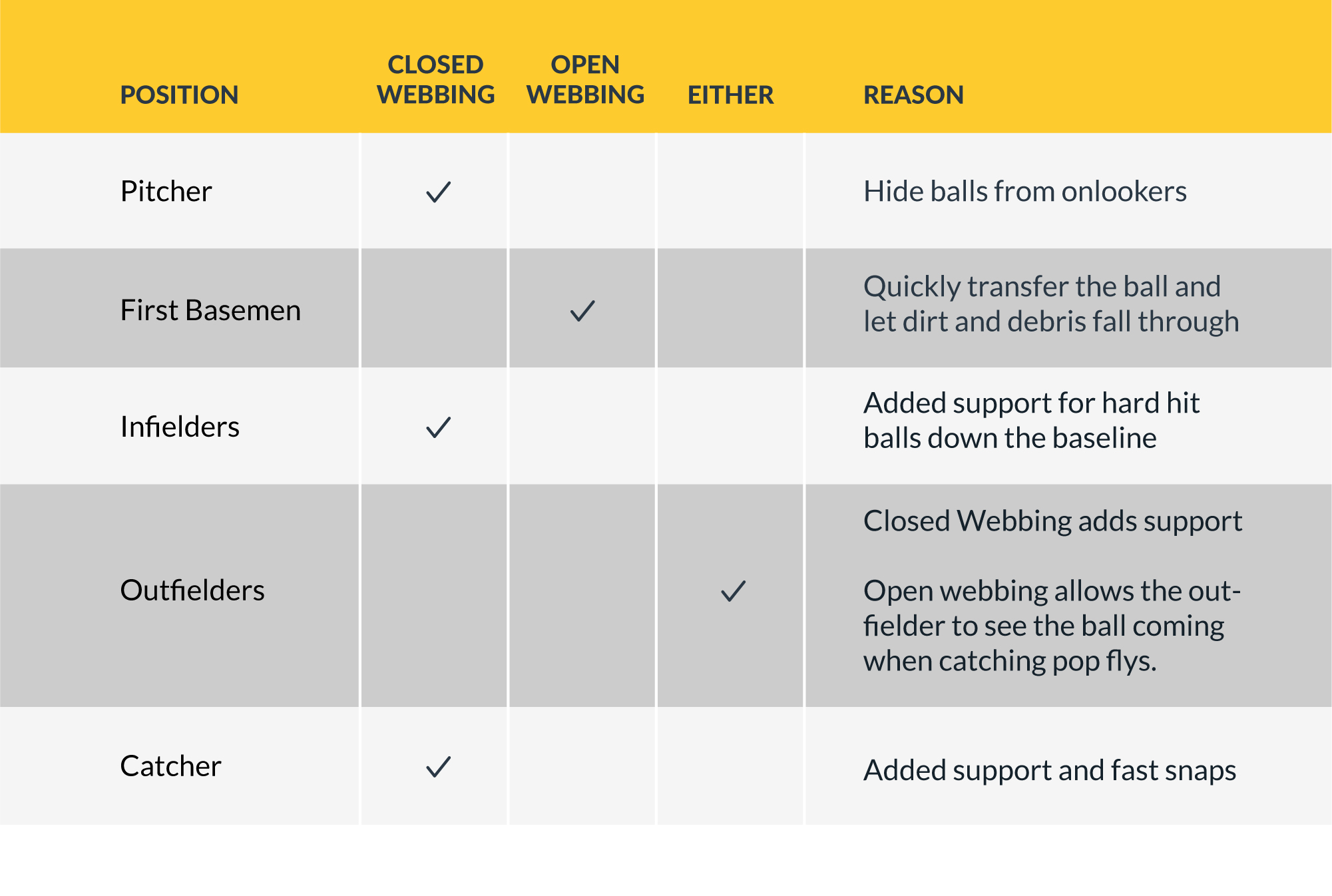
There are two basic types of webbing, open or closed. Pitcher gloves often feature a closed web to help them hide the ball from onlooking hitters. Outfielders and third basemen also tend to enjoy closed webs because of the extra support. Middle infielders tend to lean more towards an open web so they can transfer the ball out of their glove faster.
Understanding Baseball Glove & Softball Glove Pockets
Where is the pocket of a baseball or softball glove?
The pocket of a baseball glove is the cupped area at the base of the web—between the thumb, index finger, and padded palm—where the ball naturally settles after a catch. Rather than being a separate piece of leather sewn into the shell, the pocket is formed by how the palm, web, thumb, fingers, and lacing work together as the glove breaks in. A brand-new glove is often stiff without a visible pocket; to spot where it will form, place a ball inside the palm just below the base of the web and see where the leather cradles it. Knowing where the pocket of a baseball glove is helps you evaluate patterns while shopping, break in stiff leather properly, and catch cleanly without stinging your palm.
How Glove Anatomy Shapes the Pocket:
- The Web: Positioned between the thumb and index finger, [Internal Link: different glove web types]—such as I-webs, H-webs, basket webs, and trapeze webs—help trap the ball and dictate how much the pocket gives on impact, an evolution that completely transformed [Internal Link: history of baseball gloves].
- Thumb, Fingers & Back Design: Finger lacing prevents the ball from pushing through, while a longer thumb or structured closed-back pattern (like the [Internal Link: Rawlings Fastback] or position-specific patterns popularized by the Wilson A2000) alters flexibility and pocket volume.
- Palm, Heel & Wrist: The padded palm cushions impact directly behind the pocket, wrist straps lock in hand fit, and heel lacing holds the base shape—and can be adjusted if you ever [Internal Link: relace a baseball or softball glove].
How deep should your glove pocket be by position?
While every glove's pocket sits in the same general location, ideal pocket depth depends on your position, ball size, and hand strength:
| Position / Player Type | Ideal Pocket Depth | Common Webs & Patterns | On-Field Advantage |
| Middle & Corner Infielders | Shallow to Medium | I-Web, H-Web, Single Post | Fast ball-to-hand transfers on grounders and double plays |
| Outfielders | Deep | H-Web, Trapeze, Modified Trapeze | Maximum ball security on fly balls and diving catches |
| First Basemen | Wide & Deep (Scoop) | Single Post, Double Post, Modified T | Built to scoop low throws in the dirt and secure tags |
| Youth Players | Medium & Easy-Close | Basket, H-Web, Modified Trapeze | Balances ball retention with a soft squeeze for smaller hands |
| Softball Players | Wide & Naturally Deep | H-Web, Basket, Closed/Laced Webs | Accommodates larger 11" and 12" softballs |
To recap, the size of the pocket will depend on the position you play. Shallow pockets are built for middle infielders. This allows them to retrieve the ball quicker and complete plays in a faster manner. Deeper pockets help outfielders secure fly balls with more consistency. Softball players will need a bigger pocket due to the larger-sized softballs used. As a result, softball gloves are naturally made with larger pockets.
- Infielders: A shallow pocket baseball glove keeps the ball near the surface so middle infielders can find the seams quickly and complete rapid transfers—similar to the quick-hands drill mechanics practiced when [Internal Link: fielding with a pancake glove]. Pair a shallow-to-medium pattern with the [Internal Link: best glove web for an infielder] to prevent the ball from getting buried.
- Outfielders: When comparing [Internal Link: infield vs. outfield gloves], outfielders benefit from a deep pocket baseball glove—a concept popularized early on by Rawlings' Bill Doak model—with longer fingers that wrap around high-velocity fly balls so they don't pop out on the run.
- First Basemen, Youth & Softball Players: A dedicated [Internal Link: first base mitt] combines a curved edge and deep pocket built specifically for scooping throws out of the dirt. Meanwhile, [Internal Link: youth baseball and softball gloves] prioritize a pocket that holds the ball securely without requiring adult hand strength to squeeze shut. Because softballs have a larger circumference, patterns built around the [Internal Link: difference between a baseball glove and a softball glove] feature naturally wider, deeper pockets.
.jpg)
.jpg)
Quick Tips: Shaping & Maintaining Your Glove Pocket
Because new leather arrives stiff, how you break in your baseball or softball glove determines your pocket's final depth and feel:
- Soften the Leather Lightly: Work a small amount of one of the glove conditioners into the palm, web, and hinges—never saturate the leather with heavy oil, and never use microwaves or ovens. (Tip: Avoid shoving an adult hand into a youth glove, which permanently stretches the finger stalls.)
- Wrap Around a Ball: Place a baseball (or a softball if your position calls for extra depth) directly in the pocket, fold the thumb and pinky around it, and secure it overnight with a wrap or rubber bands.
- Play Catch & Store Properly: Playing regular catch reinforces how to catch a baseball cleanly in the pocket rather than the palm. Off the field, learn how to store a baseball glove indoors—away from hot cars or damp garages—with a ball resting in the pocket to maximize how long baseball and softball gloves last.
Backs of a Glove by Position
This portion of the glove is based on player preference and can be open or closed above the wrist on the backside of the glove. Middle infielders like an open back for the flexibility they afford. Outfielders often gravitate towards a closed back and a finger hole for the extra wrist support provided.
Shop by Position:
First Basemen Gloves
History of First Basemen Gloves
In 1870, the first glove worn by a baseball player was worn by catcher Doug Allison of the Cincinnati Red Stockings. According to reports at the time, he wore the glove because of an injured left hand. Conversely, A.G. Spalding believes the first glove he ever saw on a player was worn by Charles C. Waite, in Boston, in 1875. Waite was playing first base, and when asked by Spalding, he said, "He was a bit ashamed to wear it, but had it on to save his hand. He also admitted that he had chosen a color as inconspicuous as possible (flesh color, as it was said) because he didn't care to attract attention." Spalding, who became the owner of A.G. Spalding and Bros., did not wear a glove until 1877. The glove Spalding wore was made from black leather and did draw attention to it. Since Spalding had made a name for himself, the attention was more out of pity than humor. By the mid-1890s, gloves were becoming not only more popular but also the new standard.
- First basemen wearing gloves became a standard in the late 1890s.
- First base mitts, as we know today, were invented in 1941.
- Early first base mitts had the five-finger stalls with padding and then locked together with lacing between the thumb and index finger.
- Although it was primitive in makeup, the five-finger stalls with padding style was effective and more widely adopted.
- First base mitts now offer open and closed backs, single post or double post webs, and modified or closed webs.
What to Look For in a First Baseman's Glove:
- Main Characteristics: Single First base gloves are unique because the fingers aren’t separated. This allows first basemen to easily scoop up poorly thrown balls. They are also a bit longer than other gloves to help catch rolling balls.
- Webbing: Open Single-Post, Dual Post, or H-Webbing allows first basemen to grab balls from the ground without also digging up dirt and dust.
- Pocket Size: Large, deep pockets allow first base players to more securely grab and hold onto the balls that come their way.
- Other traits to look out for: First base gloves should be sturdy enough to take a high volume of pitches. Leather provides long-lasting strength to allow first basemen to catch ball after ball.
Today, the first base mitts offer many different types of leather combinations from cowhide to kangaroo. Also, there are options for the color of your glove and the different features that your glove offers.
Catchers Mitts
History of Catcher's Mitts
The catcher's position is baseball's most physically demanding position. So, the need to improve catching equipment is important in order to add more protection and comfort. A catcher's mitt for people who play the position is a "must-have" because no other glove can provide the kind of support, protection, durability, and performance needed.
Baseball gloves, in general, became of widespread use by the 1870s. The first person to start producing and marketing ball gloves was Albert Spalding, who started his own mail-order sporting goods business. His mitts were a fingerless glove with padding in the palm. In the beginning, most of his business came from catchers who wanted more padding and protection for their mitts.
- In 1890, an ex-catcher by the name of Harry Decker patented his very own "Decker Safety Catcher's Mitt," which was a flat cushion with straps to hold it onto the hand, specifically designed for catchers. These were basic designs, but they laid the groundwork for better and more advanced designs.
- Over the years, catchers' mitts have added not only padding but have developed more of a basket pocket, similar to what we have today.
- Catcher's mitts now have an oval-shaped pocket, more padding, and more flexibility. Today's gloves have been developed using the latest technology and are much stronger and more durable.
- All of today's baseball catcher's mitts have a closed web.
What to Look For in a Catcher's Mitt:
- Main Characteristics: Like a first baseman’s mitt, a catcher’s mitt does not have differentiated fingers. This is just right for catching and keeping balls that come your way. Catcher’s mitts are also well padded to help with catching high-velocity throws.
- Webbing: A Closed Web or Modified Trap mitt works best for catchers to keep the ball in place.
- Pocket Size: Deep pockets help catch and hold the ball in place.
- Other traits to look out for: When selecting a baseball catcher's mitt, there are several things you need to keep in mind for you to select the right mitt. First, mitts come in different sizes, such as youth and adult sizes. But you must also decide the glove circumference. Youth sizes have circumferences 31 inches or less, and adult mitts have circumferences of 32 inches or greater.
When selecting a baseball catcher's mitt, there are several things you need to keep in mind for you to select the right mitt. First, mitts come in different sizes, such as youth and adult sizes. But you must also decide the glove circumference. Youth sizes have circumferences of 31 inches or less, and adult mitts have circumferences of 32 inches or greater.
There is also the choice of an open-back mitt that has an opening on the back of it right above the wrist, or there is a closed back, which will have a finger hole for the index finger to be placed on the backside of the glove for more support. A few more factors to consider when choosing a catcher's mitt are 1) color and 2) brand preference.
Infield Gloves
History of Infield Gloves
In the very first years of baseball back in the 1860s and 1870s, gloves were seen as unmanly. Then, as the game gained popularity and players became better and hit the ball harder, gloves became more common and necessary for protection. The first infielder's gloves were a pair of gloves. They were leather gloves worn on each hand with the fingers cut off. By 1900, people started to wear only one glove on their non-throwing hand with more padding and a larger pocket. This was the beginning of the basic concept of the gloves we have today.
As time has gone by, many improvements have taken place with gloves, especially infielders' mitts. With infielders having so little time to react, having a good glove improves their play greatly. The most important improvement was in 1920, when a web was designed in between the thumb and the finger stalls. This gave the gloves a larger and deeper pocket
What to Look For in Infield Gloves:
- Pitching Gloves: Pitchers want a glove that has a solid web; this is because the solid web will hide their fingers as they adjust their grip on the ball for the next pitch. As for the size of the glove for pitchers, it is up to personal preference.
- Middle Infielders: Smaller mitts allow middle infielders to transfer the ball out of the glove to their hand as quickly as possible. Open web gloves are also preferred by middle infielders, such as an I-web or H-web style glove.
- Second Basemen: Second basemen wear the smallest gloves because they are lighter weight. Most second basemen use an 11 to an 11.5-inch mitt, while shortstops will usually use an 11.5 to an 11.75-inch mitt.
- Third Basemen: Third basemen, on the other hand, will often wear a bit larger glove around 12 to 12.5 inches long because they are the closest fielder to home plate. Balls hit at third base are the hardest hit and come in fast. Plus, a longer glove allows them to pick up balls hit down the foul line more easily, because of the long reach of the glove.
- Other traits to look out for: Some other factors that can play a role in deciding which glove to choose are a brand preference or the color of the glove.
Outfield Gloves
History of Outfield Gloves
When gloves first became popular among those who played organized baseball, gloves were not specific to a position. Gloves were made from old mittens or custom-made from horsehide with extra padding added to both designs. More and more padded designs became available as hitters began to hit the ball harder. In 1920, Bill Doak of the St. Louis Cardinals approached Rawlings with his idea of lacing a web between the index finger and thumb to create a more natural pocket. This idea revolutionized the way gloves were made. This pocket design is what is still used today on all fielder gloves. It is like having an extra finger. All-Star Ozzie Smith, who used this design, said: "Six fingers are better than five."
What to Look For in Outfield Gloves:
- Main Characteristics: Outfielders often need large gloves with deep pockets to ensure that they can catch and hold those far-field, high-speed balls.
- Webbing: Outfielders prefer a closed web style.
- Size: Outfield gloves tend to be larger in design than infielder models in terms of the length of the finger stalls. These larger gloves allow outfielders to be able to cover more ground. Also, outfielders are looking to make a catch, while infielders, who like smaller gloves, need to retrieve and release the ball as quickly as possible. Because of this, deep pockets are ideal for outfielders. Today, many different models and sizes are available for outfielders. The most common sizes are twelve inches and above, depending on personal preference.
- Other traits to look out for: When selecting an outfielder's glove, you will first need to select the size that best fits your personal needs. The next thing you need to think about is the web style that you will like, whether that's an open web or a closed web. The third step will be to choose if you have a preference for an open back or a closed back. Your next decision will be to see if you have a brand preference. Finally, you will make the purchase that best fits your specific needs. Gloves have changed over time and will continue to change for the better of the game.

Want help finding the perfect baseball glove or softball glove? Our knowledgeable Glove Experts are available by email: support@JustGloves.com, Live Chat, or toll-free phone number: 1-866-321-4568! *